

If you’ve seen “AIforce” in your feed since Dreamforce 2026 and assumed it was a typo for Agentforce, you’re not alone. It isn’t a typo. AIforce is an official Salesforce term, and it means something different from Agentforce.
Is "AIforce" Official Salesforce Terminology?
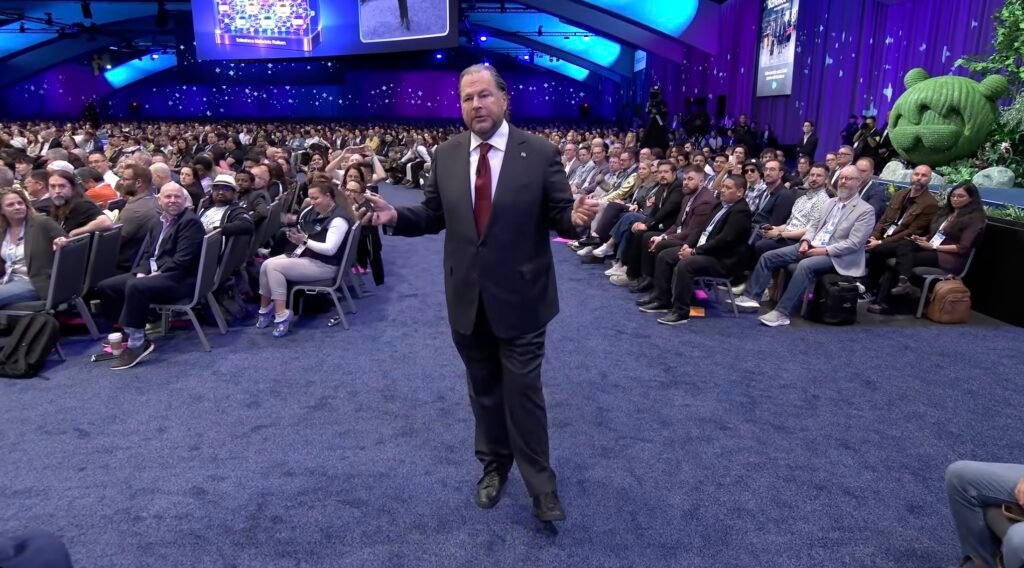
Yes. Salesforce announced AIforce at Dreamforce in September 2026 and called it “a live interface layer that brings the full power of Salesforce to wherever people and agents work.”
Salesforce Help has a dedicated article, Welcome to AIforce, and it opens with an important clarification: AIforce “isn’t a single product or tool.” It’s an approach that brings your Salesforce context into the interface where you want to work, whether that’s Slack, your Salesforce org, or an agentic tool like Claude.
Salesforce’s own AI page explains how AIforce differs from Agentforce. Agentforce is “Salesforce’s product for building and running AI agents,” while AIforce is “the broader idea of bringing Salesforce’s trusted data and AI (including Agentforce) into the everyday tools you already use.”
The Problem AIforce Is Trying to Solve
Salesforce’s reasoning is simple. Much of a company’s customer knowledge sits in Salesforce, but until now most people reached it only by opening the app and clicking through the UI. According to the announcement, that limited who used Salesforce and how much value they got from it.
AIforce reverses that. In Salesforce’s words, people don’t have to come to Salesforce to get work done, because Salesforce comes to them in Claude, Slack, Lightning, or wherever they work. Someone who never opens a dashboard could ask a question, update a record, or trigger a workflow from a chat window, and the answer would still be grounded in real Salesforce data and business logic.
The announcement also describes customized “live interfaces.” Instead of working only within fixed page layouts and fields, people can describe the view they need and have it built inside tools like Slack, Claude, or Coworker.
The Three Launch Interfaces
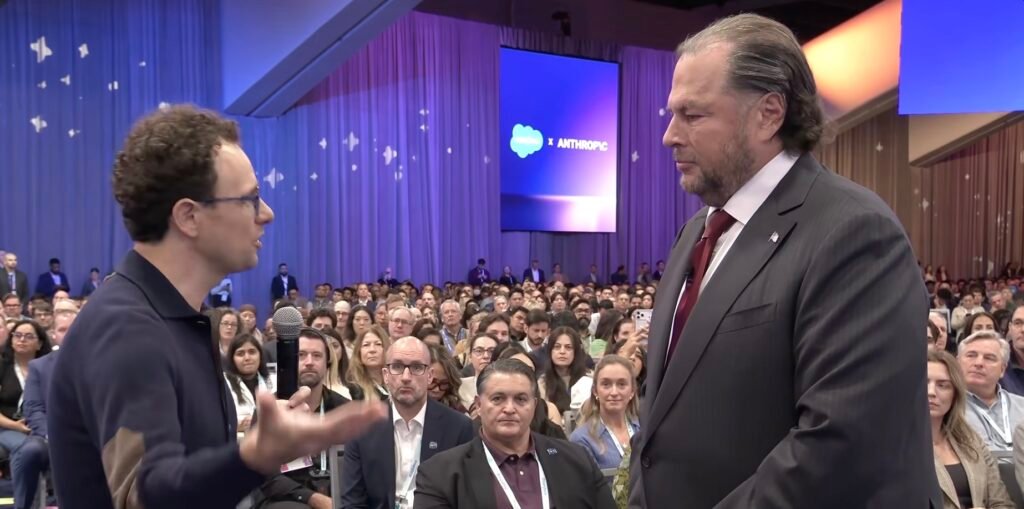
According to the announcement, AIforce launched with Claudeforce, Slackforce, and Agentforce Coworker.
Claudeforce (Salesforce in Claude)
Claudeforce extends the partnership between Salesforce and Anthropic. Its first offering, Salesforce in Claude, packages Salesforce access into a prebuilt MCP server inside Claude. MCP (Model Context Protocol) is an open standard that lets AI tools connect to outside systems in a structured way. Salesforce in Claude includes 37 prebuilt sales skills that cover tasks from prospecting to pipeline hygiene. The announcement also mentions a Salesforce Development plug-in for Claude Code with more than 40 skills.
Availability: The AIforce announcement says Salesforce in Claude “is now available to all customers in beta.” The earlier Claudeforce press release (August 26, 2026) described a pilot followed by an open beta in September 2026. Treat it as a beta feature and confirm current availability before you plan around it.
Slackforce
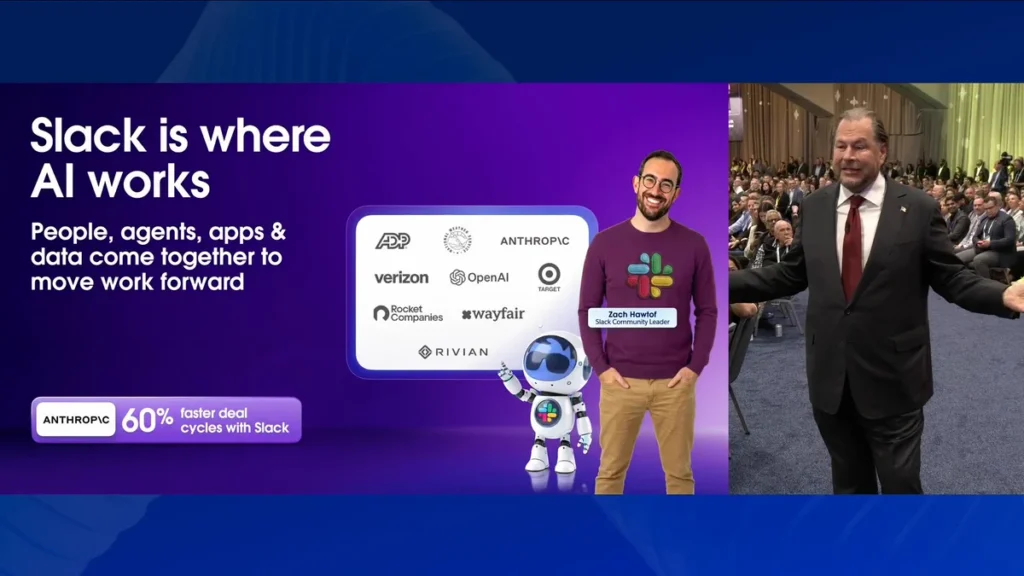
Slackforce brings Salesforce into Slack. Slackbot, the AI assistant in Slack, can read from, write to, and take action across Salesforce through MCP. Slack CRM brings CRM capabilities directly into Slack. Slackforce Surfaces turns data into interactive views inside Slack that stay connected to the source, unlike a one-time export. The AIforce announcement also lists Slack Code, a shared space in Slack for working with a coding agent.
Salesforce says Slackforce Surfaces is available on several Slack plans when Slackbot is enabled, and that the live data feature began rolling out in October.
Agentforce Coworker
Agentforce Coworker is described as an AI teammate in the Lightning interface. It reasons across accounts, activity, and history, and it can call the Agentforce agents your company has already built. Salesforce says it can be turned on with “no migration, no new permissions model,” and that 100,000 users activated it within its first 35 days.
The Coworker product page lists more places beyond Lightning: “Salesforce, Slack, Microsoft Teams, Claude, ChatGPT, and mobile.” It also says Coworker “respects your governance and sharing rules.”
The Headless Toolkit: The Engine Behind AIforce
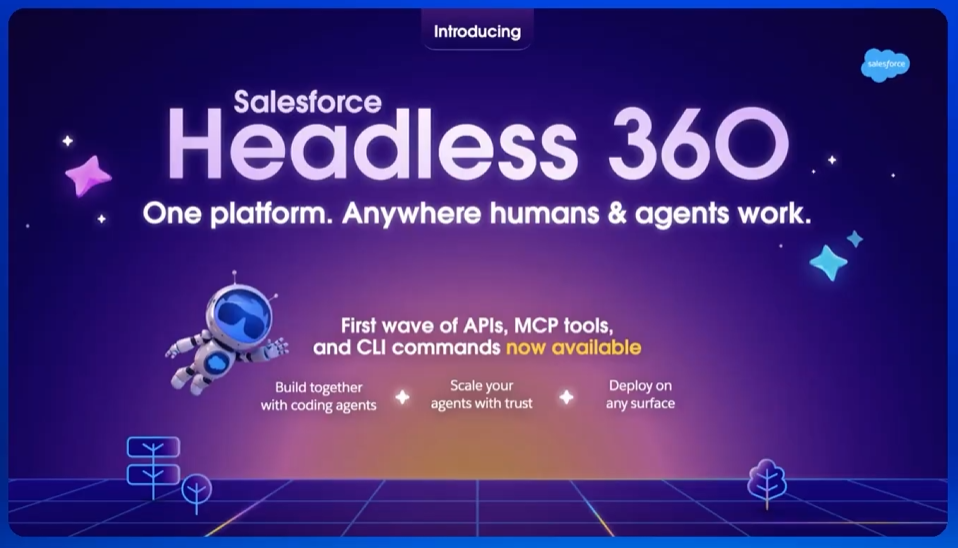
Salesforce Help says AIforce is powered by the Headless Toolkit. That toolkit includes MCP servers, skills, and Agentic Setup, built on a data, metadata, API, and CLI layer. Underneath, a trust and security foundation automatically applies your org’s permissions and scope to every agent and interface.
“Headless” means separating Salesforce’s data and business logic from the browser screen, so AI tools and apps can use them directly. The Headless Toolkit page lists more than 60 new MCP tools, more than 30 preconfigured coding skills, and support for frameworks like React.
You don’t have to be technical to benefit. Salesforce’s AIforce FAQ says ready-made experiences like Salesforce in Claude “work out of the box with minimal setup required,” and building with the Headless Toolkit is “optional, not required.”
You may also see the name Headless 360 in some official resources, including the Trailhead module. Both names refer to this headless approach.
Where Agentforce and Einstein Fit
Agentforce
Salesforce calls Agentforce “the AI agent platform.” It defines an AI agent as software that uses generative AI to decide what to do and which tools to use, “instead of following a script written in advance.” That’s the key difference from a traditional chatbot, which follows fixed conversation flows. It also differs from a copilot, which assists while a person does the work.
In simple terms, Agentforce provides the agents, and AIforce brings those agents, along with your data and processes, into the tools people already use.
Einstein and the Einstein Trust Layer
Einstein is Salesforce’s long-standing brand for built-in AI. Salesforce describes it as “natively embedded into the Salesforce Platform,” providing “insights, predictions and generated content directly in the flow of work.”
The name still appears in the Einstein Trust Layer, which Salesforce Help describes as “a secure AI architecture, built into the Salesforce platform.” According to that article, the Trust Layer includes:
- Zero-data retention with third-party LLM providers
- Dynamic grounding, which pulls in Salesforce data based on the permissions of the person running the prompt
- Data masking of sensitive data before a prompt reaches the LLM
- Toxicity scoring
- Audit logging of prompts, responses, and trust signals in Data 360
That Help page uses the name Data 360, which is how current Salesforce documentation refers to its unified data platform.
Security: What Salesforce Says, and What to Check
For most companies, trust is the deciding question. The AIforce announcement says every request runs on existing permissions and business rules, so “every agent sees only what the person asking can see.” It also says business data “is not retained by the model provider.”
These are Salesforce’s stated design principles, and every company should still validate them in its own environment. The Welcome to AIforce Help page links to articles on security and governance in headless experiences, and on legal and ethical considerations to review before you deploy. The announcement also notes that pricing, packaging, and regional availability may change and are governed by customer agreements.
A Real-World Example: BACA Systems
A Salesforce customer story from June 2026 shows these ideas in use. BACA Systems, a U.S. maker of stone fabrication equipment with about 50 employees, built an Inventory Agent on Agentforce that runs in Slack and other internal tools. Salesforce reports that it accurately handles 70–80% of inventory queries. BACA also uses Agentforce Coworker for conversational search, which lets staff run complex data queries in seconds instead of hours.
This is the AIforce idea in a small company. People ask questions where they already work and get answers from Salesforce data without opening Salesforce.
What AIforce Means for Anyone Working With Salesforce
You don’t need a particular job title to get value from AIforce. A few practical points apply to everyone:
Salesforce is no longer only a destination. More work will happen in chat tools and AI assistants, with Salesforce working underneath. Knowing which data lives in Salesforce, and how it’s organized, becomes more useful than knowing which screen to click.
Permissions matter more than ever. AI tools act within the access of the person asking, so a user’s permissions effectively become the limits of what their AI tools can see. If access in your org is too broad, AI makes that more visible. Reviewing who can see what is a sensible first step for any team.
You can start without building anything. Ready-made options like Salesforce in Claude and Agentforce Coworker work with minimal setup. Custom builds with the Headless Toolkit are available if and when your team needs them.
FAQs
What is AIforce Salesforce?
AIforce is Salesforce’s interface layer, announced at Dreamforce 2026. It brings Salesforce data, workflows, permissions, and governance into tools like Claude, Slack, and Lightning.
Official source: Salesforce Help — Welcome to AIforce
Is AIforce an official Salesforce product?
It’s official Salesforce terminology, but Salesforce Help says it “isn’t a single product or tool.” It brings together Claudeforce, Slackforce, Agentforce Coworker, and the Headless Toolkit.
Official source: Salesforce Help — Welcome to AIforce
Is AIforce the same as Agentforce?
No. Agentforce is the product for building and running AI agents. AIforce is the broader idea of bringing Salesforce data and AI, including Agentforce, into everyday tools.
Official source: Salesforce — AIforce
What's the difference between Einstein and Agentforce?
Einstein is Salesforce’s established brand for built-in AI such as insights, predictions, and generated content, and the Einstein Trust Layer still protects generative AI features. Agentforce focuses on AI agents that plan and take actions.
Official sources: Salesforce — Agentforce · Salesforce Help — Einstein Trust Layer
Do I need to be a developer to use AIforce?
No. Salesforce says ready-made experiences like Salesforce in Claude work out of the box with minimal setup, and building with the Headless Toolkit is “optional, not required.”
Official source: Salesforce — AIforce (FAQ section)
Where can I learn more about AIforce?
Start with the Welcome to AIforce article in Salesforce Help, then try Salesforce’s free Trailhead module, Introduction to AIforce. It takes about 40 minutes.
Official source: Trailhead — Introduction to AIforce
Conclusion
AIforce Salesforce is real, it’s official, and it isn’t another name for Agentforce. It’s Salesforce’s approach to bringing data, processes, and governance to wherever work happens: Claude through Claudeforce, Slack through Slackforce, and Lightning and other apps through Agentforce Coworker. The Headless Toolkit powers it, and the Einstein Trust Layer protects it.
Some pieces are still new. Salesforce in Claude is in beta, and names like Headless 360 and Headless Toolkit are still settling. Check current availability before you plan around a specific feature.
A practical next step: Read Welcome to AIforce in Salesforce Help, then complete the Introduction to AIforce module on Trailhead. Then look at your own Salesforce setup and ask who can see what, because whatever people can access, their AI tools can access too.