

Every Salesforce professional who flew into San Francisco this September carried the same quiet worry. If AI can spin up software on demand, what happens to the CRM we all work in? The industry even gave that fear a nickname: the SaaSpocalypse. Marc Benioff spent much of his Dreamforce 2026 keynote answering it, and his answer frames everything else Salesforce announced.
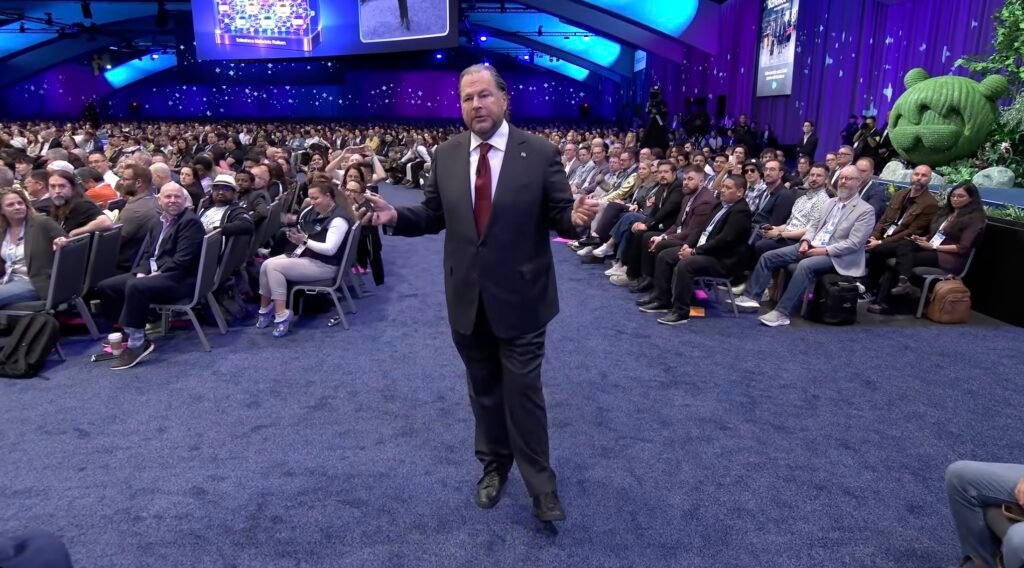
Dreamforce 2026 ran September 15 to 17 at the Moscone Center. From the main stage, Benioff told the room that 53,000 people had come in person, with around 10 million watching online across more than 1,500 sessions. The theme was the agentic enterprise, and the message to admins, consultants, and business teams was blunt: the moat is not the software. It is your data, your permissions, and the trust around them. An AI agent is only as good as the data and guardrails you hand it.
AIforce: Salesforce comes to where you work
The headline announcement was AIforce. In plain terms, it lets people use Salesforce data and take Salesforce actions from the tools they already sit in all day, without opening the Salesforce app. Your records, your sharing rules, and your permissions travel with you into Slack, into Claude, and into other surfaces, so an action taken outside Salesforce still respects who is allowed to see and do what.
For admins and consultants, that reframes a familiar goal. For years the job was getting users to live inside Salesforce. AIforce shifts the work toward keeping the data, permissions, and automation behind the scenes clean enough to trust wherever they show up.
Claudeforce: Salesforce and Claude, working together
Claudeforce is the expanded partnership between Salesforce and Anthropic, the company behind the Claude AI assistant. For accuracy: Salesforce announced Claudeforce on August 26, 2026, a few weeks before Dreamforce, then put it center stage at the conference.
The piece most teams will touch first is a plugin called “Salesforce in Claude,” which ships with 37 prebuilt sales skills so you can pull live pipeline numbers, update records, and trigger Salesforce actions from inside Claude. Claude also became the default AI model inside Slack. If your org already runs on Slack, that is a change you will feel without installing anything.
Koa: Salesforce's own AI brain for CRM
The most talked-about technical reveal was Koa, Salesforce’s first reasoning model built specifically for CRM work. Salesforce did not build it from scratch. It took NVIDIA’s open Nemotron model and trained it further on synthetic examples that mimic decades of CRM activity, which matters for one reason in particular: real customer data was kept out of the training. On its own CRM benchmark, Salesforce says Koa makes roughly three times fewer mistakes on CRM tasks. That figure comes from Salesforce’s own test, and at least one outside analysis read the results less favorably, so weigh it accordingly.
One correction worth making, because it spread widely: Koa did not replace the Atlas Reasoning Engine. Atlas is still there, now often powered by Claude, and Koa is an extra model you can assign to a specific agent or step inside Agentforce. Koa entered pilot at the show, with wider US availability expected over the winter.
Meet the seven job-ready agents
Salesforce gave its prebuilt agents human names and clear day jobs, which makes them far easier to discuss with a business team. Six are generally available now. The seventh, Hunter, stays in pilot with general availability targeted for November 2026.
- Casey handles customer service across voice, SMS, WhatsApp, and web chat.
- Paige takes IT and HR requests through Slack and self-service portals.
- Carter helps shoppers and can complete checkout inside a chat.
- Marshall runs supply-chain and back-office processes.
- Piper works inbound leads from your website and inbox to build pipeline.
- Fin covers customer-experience workflows across channels.
- Hunter does outbound sales, from research to outreach, and is the first agent built for long-horizon work that plays out over days or weeks.
Multi-Agent Orchestration, now generally available, lets these agents hand work to one another, so a lead Piper warms up can pass to a person or another agent to close.
Does it actually work? The customer numbers
This year leaned hard on customer proof, so it helps to read the numbers with care, because most come from the companies themselves.
Fulton Bank said Agentforce saved about 80,000 hours and contributed $389 million in loans and deposits, and that thousands of employees were using agents within six weeks. The hours figure is the kind banks track routinely. The dollar figure is company-reported, and Salesforce has not published how it was calculated, so treat it as a headline rather than an audited result.
Staffing group Adecco was the other standout. CEO Denis Machuel said agentic AI frees 35 to 40 percent of recruiter time, that prescreening coverage climbed from roughly one in ten candidates to all of them, and that the company is rolling Agentforce out to 27,000 staff across more than 40 countries. A widely repeated figure credits 20,000 extra placements this year, though that one has thinner public backing.
Trust, data, and a loud debate about AI rules
Underneath the product news, Benioff kept returning to trust. “Your data is your data,” he told the room, stressing Salesforce’s zero-data-retention stance that customer information is never used to train anyone’s models. With Claude, NVIDIA’s models, and Slack now in the mix, that promise is doing a lot of work for cautious buyers.
Dreamforce also landed in the middle of a real argument about AI regulation. Benioff pressed the AI industry to police itself or face lawsuits, while NVIDIA CEO Jensen Huang, on stage with him, argued that market forces should shape AI more than new rules. For Salesforce customers, the practical takeaway is that governance and data quality are moving from back-office chores to front-line requirements.
What it means for Salesforce professionals
Strip away the branding and a clear job emerges for the people who run Salesforce every day. Agents inherit whatever your data and permissions allow, so clean records, tight sharing rules, and sensible field-level security become the difference between an agent that helps and one that embarrasses you. Salesforce described the ongoing work as giving every agent an operating rhythm: someone owns what the agent does, watches where it falls short, and turns that into tested improvements. That is a role most Salesforce professionals are well placed to own.
If you want one low-risk place to start, watch how Claude behaves as the default model in Slack, then read up on the “Salesforce in Claude” beta before deciding whether to pilot an agent in your own org.
Dreamforce 2026 had no single magic box to buy. Its real message was that AI agents are now ordinary Salesforce tooling, and the teams who win will be the ones who keep their data trustworthy and their agents supervised. That is familiar ground for Salesforce professionals, which may be the most reassuring news of all.
Sources & further reading
- 21 Things We Announced at Dreamforce 2026 — Salesforce
- Five Big Ideas Coming Out of Dreamforce 2026 — Salesforce
- Salesforce Koa (product page)
- Why We Post-Trained Our Own Reasoning Model — Salesforce
- Salesforce and Anthropic Announce Claudeforce (press release)
- Adecco + Agentforce — Salesforce
- Jensen Huang at Dreamforce — NVIDIA
- Biggest Dreamforce ’26 Announcements: Everything in a Nutshell
- Salesforce’s First CRM Reasoning Model ‘Koa’ Is Revealed
- The 6 Biggest Takeaways from the Main Keynote
- Complete Roundup of the Agentforce Keynote